Showing posts with label optional chaining. Show all posts

Wednesday, August 24, 2016

Not funny, but efficient: Nil coalescing operators

For as funny as the "Who's on first?" skit is, it would all be over in a few seconds if they just exchanged lineup cards rather than falling for a series of counter-intuitive homonyms. Again, lineup cards are not funny, but they are efficient.

In the post on optional chaining, I alluded to how developers prefer to write as little code as necessary. Why write more when less will do? In talking about optional chaining, we also talked about what happens when there is no underlying value to our optional and how to handle that - in that case, by returning nil.

But what if we wanted to return something more helpful or accurate than nil? We can do that. And to do that we use nil coalescing operators. Yes, another programming term that on the surface makes little sense or does little to tell us what it actually does. We'll get to that. For now, let's take a look at nil coalescing operators.

In the last example we laid out a scenario where we bring in our defensive substitute, Steven Souza, to play leftfield for Ryan Zimmerman. But in this case, we forgot to make the substition and there's no one out in left! Fortunately, optional binding kicks in and while our value for leftFielder is nil, the program returns our else statement, "No one is playing leftfield!"
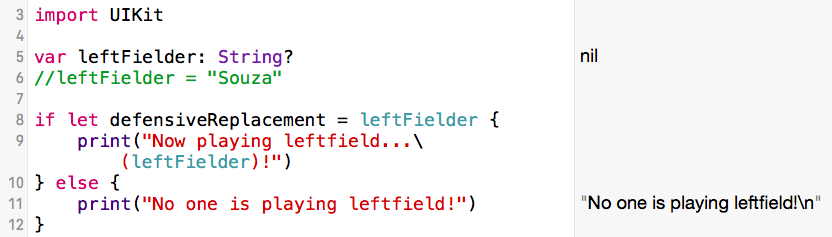


In the example below we still don't have a leftfielder, but we do have a faster way of getting to that result (line 14).


What happened? We got the program to return the same string, "No one is playing leftfield!" two different ways. The first way, through optional binding, took about four lines of code (lines 8-12). The second way, with a nil coalescing operator, all took place on line 14. Not too shabby. Here's what the trimmed down version looks like:


Now how do we make sense of that nil coalescing operator moniker? Here's how I explain it to myself: coalesce means to come together to form one group or mass. Here the ?? operator is bringing together the nil value of the empty optional (the stuff to the left of the ??) with the outcome based on what should happen when that optional value is nil (the stuff to the right of the ??) to form a single respone which, in this case, is "No one is playing leftfield!"

We can even take the nil coalescing operator a step further and work in some optional chaining like this:


Pretty slick, right? We can read this as, "If there is a value for leftFielder then capitalize it and return it. If the value for leftFielder is nil, then return, 'No one is playing leftfield!'"

Challenge: Take the example you wrote in the optional chaining post and re-write it using optional chaining then tweet it at me (@randallmardus).

On Deck: Force unwrapping optionals

Tuesday, August 23, 2016

Steven Souza, No-No Saving Catches, & Optional Chaining

In the last post, we talked about how optional binding is like a late inning defensive replacement: It's Steven Souza, Jr. taking over left-field for Ryan Zimmerman to secure Jordan Zimmermann's no-no for the Nationals in 2014.


But what if you wanted to bring in a defensive replacement and then have the PA announcer introduce that defensive replacement? In other words, what if you wanted to perform an action after checking to see if the value is there or not?

Why would you want to do this? Because it is more efficient than performing optional binding and then writing a function with a couple possible outcomes depending on whether or not there was a value behind the optional. And, as they say, developers are lazy so why write more code than is needed?

Here's what that looks like:


So what is happening here? First, we did some optional binding in line 8. Then, after that block of code (ie, the stuff between the two { } brackets) that's where we did our optional chaining and we did it by creating a new variable.

What exactly is going on in line 14? Let's read it out loud: If there is a value for leftFielder, then put it in uppercase and set it to the variable nowPlayingLF. Fortunately, there is and we get "SOUZA" returned on the right hand side. We are chaining the result of whether or not there is a value for our optional (the variable leftFielder) to what we then want to do with that value (uppercase it).

And what happens if there is no one out in leftfield, that is, there is no name, no data, no value for our leftfielder optional? Here's what happens:


What is happening here? First, we commented out line 6 so that the optional, leftFielder, has no value. Then we did some optional binding in line 8. From line 8 the program can tell that there is no value for leftFielder so it runs the else statement (line 11) and declares, "No one is playing leftfield!"

Outside that code block (after the { } brackets), we run our optional chaining like we did before, but this time it returns nil. Why? Let's read it out loud: "If there is a value for leftFielder, then put it in uppercase, but if there is no value for leftFielder assign nil to the variable nowPlayingLF." And that's how we got there.

Challenge: Re-write the code above with your favorite defensive replacement and the position s/he came in for and then tweet it to me at @randallmardus.

Up Next: Optionals & Nil Coalescing Operators